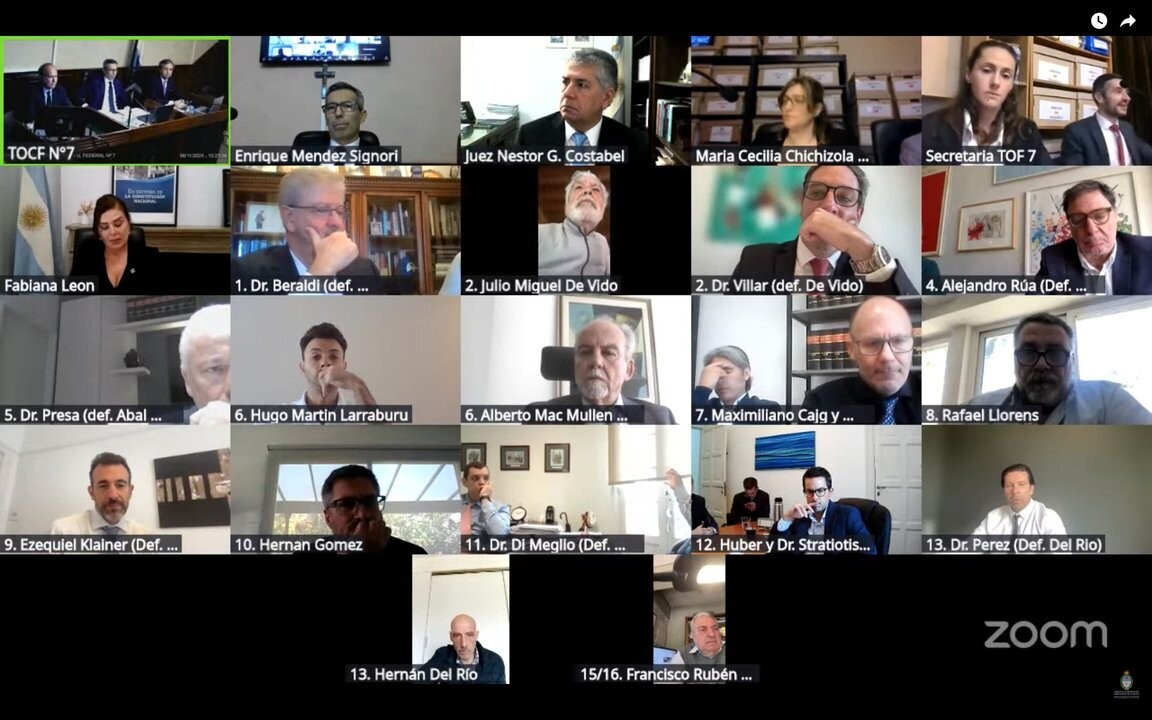
Buenos Aires, December 3 (NA) – The oral trial over the writings of Oscar Centeno will resume this Thursday at 9 a.m. with the reading of one of the most forceful sections of the prosecutor's request. After the failed recusal motion presented by Julio De Vido's defense consumed much of the hearing, the Federal Oral Court No. 7 will proceed with the last 47 pages of the third request to elevate to trial, where the prosecution exposes the backbone of its accusatory thesis: the existence of an organized, stable, and hierarchical system of illegal fundraising operated from the Ministry of Planning between 2003 and 2015. The final part of the third request addresses the probative assessment of the statements of collaborating defendants. In each episode, the ruling details the factual evidence that links communications, movements, awards, and the presence of involved officials. So far, the reading has focused on reconstructing facts and describing actors; what follows is the presentation of how prosecutor Carlos Stornelli assembled all that information to sustain his strongest claim: that a centralized criminal structure existed, whose circuits, according to the accusation, ended in the Uruguay Street office or in Olivos Presidential Residence, where former Secretary to Néstor Kirchner, Daniel Muñoz, would have received the funds on behalf of the highest authorities of the Executive Branch. It is also planned to read the section referring to Roberto Baratta, presented by the Public Ministry during the instruction as the 'key operational piece' of the fundraising circuit in dozens of attributed facts and his role as a permanent link between businessmen, intermediaries, and others. The resumption of the trial comes after an atypical day. On this section, the prosecution has accredited the existence of a dual fundraising mechanism: one executed by officials who withdrew money directly from companies and another articulated by financial actors who collected funds through agreed-upon kickbacks on the largest public works of the period. The reconstruction to be presented this Thursday in the seventh hearing details not only the operation but also the systemic behavior of the businessmen named. The fiscal analysis accuses firms such as Panedile, Faraday, Secco, and JCR of having participated in an illegal payments scheme 'induced by the certain expectation of benefits' in public contracts, tenders, deadline modifications, certifications, late payments, and regulatory management. As reported by the Argentine News Agency, on Tuesday, December 2, the court had to halt the debate for nearly four hours to analyze De Vido's recusal request, which was ultimately rejected as inadmissible. The delay in deliberation only left a few minutes to resume reading the defenses and slightly advance in the third part of the main accusation, without fully delving into the probatory analysis.